Categoría "Programación"
Se han encontrado 163 Coincidencias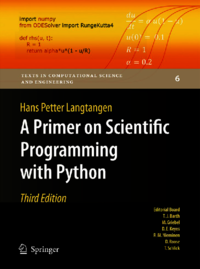
A Primer on Scientific Programming with Python
Programación en Lenguaje python utilizando problemas matemáticos y de las ciencias naturales.
322 Visitas | 303 Descargas | 2013-11-27 06:24:39 | abelm
El objetivo del libro es enseñar programación en python utilizando problemas de las matemáticas y las ciencias naturales. Utiliza algunos ejemplos de trabajo con ficheros genéticos(ADN). El Cap1 contiene trabajo introductorio con fómulas en el lenguaje python. Cap2 Ciclos y tipo de datos Lista. Cap3 Funciones. Cap4 Trabajo con ficheros y manejo de errores y excepciones. Cap5 Arreglos y Plotting. Cap6 "Clases" de la POO. Cap7 Números aleatorios y su aplicación a juegos sencillos. Cap9. Programación Orientada a Objetos. Contiene 8 apéndices dedicados fundamentalmente a: trabajo con ecuaciones diferenciales, código python en lenguajes compilados, y otros temas tecnológicos.
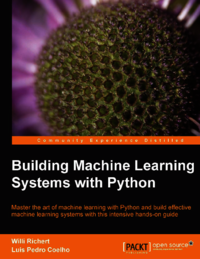
Building Machine Learning Systems with Python
Master the art of machine learning with Python and build effective machine learning systems with this intensive hands-on guide
331 Visitas | 427 Descargas | 2013-12-04 06:30:53 | abelm
Excelente libro del 2013 elaborado por programadores y profesionales de la bioinformática. El libro comienza haciendo una introducción a Machine Learning, y utilizando un ejemplo práctico y sencillo para que los estudiantes comiencen. Cap2, está dedicado en su comienzo a los problemas de clasificación con ejemplos reales, y analiza problemas más complejos de clasificación. Cap3 Agrupamiento, este capítulo utiliza un ejemplo de procesamiento de texto, añadiendo NLTK y analiza todo el proceso NLP para luego realizar clustering de textos. Capt4 Topic Modeling, un tema más complejo que analiza el LDA, similaridad en el espacio de temas(topic space). Cap5 También dedicado a clasificación pero mucho más fuerte, utiliza un ejemplo de medición de la calidad de las respuestas, es lo que se dice el análisis de un ejemplo avanzado. Cap6 Dedicado al muy actual tema del Análisis de Sentimientos, este tema es una de las tareas muy actuales del Procesamiento del Lenguaje Natural. Cap 7 y 8 dedicado a la Regresión, utiliza interesantes ejemplos para mostrar este tema de ML. Cap9 Regresa con más sobre Clasificación en este caso con un análisis del género musical, utilizando procesamiento de señales. Cap 10 Computer Vision. Cap 11 Reducción de la Dimensionalidad. Cap12 y final, como aprender de grandes colecciones de datos, aprender a procesar estos conjuntos eficientemente. Contiene un apéndice con referencias a dónde más leer para aprender sobre ML.
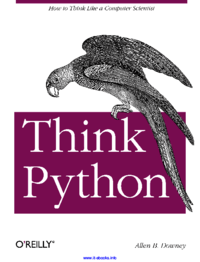
Think Python
Programación en lenguaje python.
290 Visitas | 279 Descargas | 2013-12-04 06:36:42 | abelm
Un excelente libro para aprender y enseñar a programar en python. Contiene por capítulos todos los temas de la programación orientada a objetos así como un capítulo para cada tipo de datos de este lenguaje. Es la base para el libro Think Complexity del mismo autor.
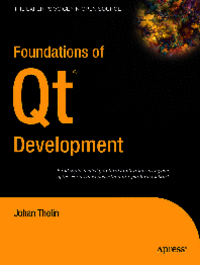
Foundations of Qt Development.
269 Visitas | 274 Descargas | 2013-12-05 19:32:28 | jltrujillo
Qt is a cross-platform, graphical, application development toolkit that enables you to compile and run your applications on Windows, Mac OS X, Linux, and different brands of Unix. A large part of Qt is devoted to providing a platform-neutral interface to everything, ranging from representing characters in memory to creating a multithreaded graphical application.

Aprenda Qt4 Hoy Mismo
288 Visitas | 331 Descargas | 2013-12-05 19:35:44 | jltrujillo
Este pretende ser el primer libro en español del mejor Framework de desarrollo multiplataforma de todos los tiempos, y que cada día nos brinda nuevas posibilidades. Es una lástima pero a día de hoy no hay ninguna traducción, ni libro dedicado seriamente a Qt 4 en nuestro idioma, por lo que me dispuse a cambiar esta situación. El enfoque que vamos a usar es por supuesto desde C++, y por lo tanto es importante poseer de antemano unos conocimientos previos de este lenguaje. El nivel necesario para comprender este libro lo completa perfectamente el libro de Bjarne Stroustrup , “El lenguaje de programación C++” publicado en español por Addison-?Wesley en 2001 (ISBN: 84-?7829-?046-?X).
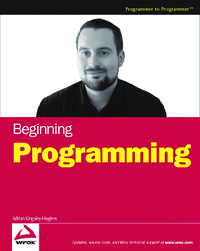
Beginning Programming
189 Visitas | 160 Descargas | 2013-12-05 19:39:19 | jltrujillo
Most computer programming books are aimed at people who are really already on the road to becoming programmers and who want to delve into a particular programming avenue. These people know the dif- ference between a function and an array and know that all good programmers declare variables and use comments. This book is different-this book is aimed at those who want to learn to be programmers but who haven’t had a background that has exposed them to programming or programmers-teachers, pupils, nurses, lawyers, lorry drivers, pilots. People who see the ability to get a computer to work for them as an advan- tage that they want to have access to. Before, programming books concentrated on people who wanted to become career programmers. This book is for everyone else!
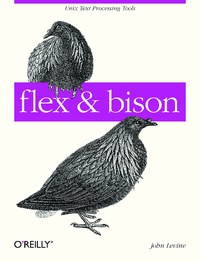
flex & bison
Compiladores
327 Visitas | 318 Descargas | 2013-12-12 15:50:48 | epcosta
flex & bison es un libro que nos adentra en el mundo de los compiladores mediante el uso de herramientas automatizadas en este caso los decendientes de lex y yacc de los sistemas unix originales.

Bison the Yacc Compatible Parser Generator
224 Visitas | 474 Descargas | 2013-12-16 20:14:03 | epcosta
Bison is a general-purpose parser generator that converts an annotated context-free grammar into a deterministic LR or generalized LR (GLR) parser employing LALR(1) parser tables. As an experimental feature, Bison can also generate IELR(1) or canonical LR(1) parser tables. Once you are proficient with Bison, you can use it to develop a wide range of language parsers, from those used in simple desk calculators to complex programming languages. Bison is upward compatible with Yacc: all properly-written Yacc grammars ought to work with Bison with no change. Anyone familiar with Yacc should be able to use Bison with little trouble. You need to be fluent in C or C++ programming in order to use Bison or to understand this manual. Java is also supported as an experimental feature.
The Definitive Guide to NetBeans Platform 7
214 Visitas | 207 Descargas | 2014-01-22 16:21:14 | karelr
Guía definitiva de la plataforma NetBeans en su versión 7. Un recorrido por las principales características de la plataforma.
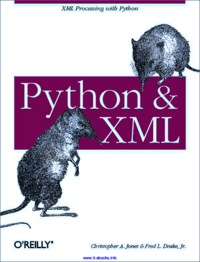
Python & XML
Trabajar con ficheros XML desde Python.
223 Visitas | 227 Descargas | 2014-02-22 02:55:14 | abelm
El libro comienza con un capítulo introductorio. Luego introducción a XML. El capítulo 3 está dedicado a SAX desde python, al igual que el 4 al DOM. Querying XML con XPath(5). Transformar XML con XSLT. Validación de XML. Python Internet APIs. Python web services and SOAP. Python y sistemas distribuidos usando XML. El libro posee además 6 valiosos apéndices donde se pueden leer: las definiciones de XML, Python SAX API, Python DOM API, MSXML y otras herramientas de python para el trabajo con XML.

CUDA by Examples
GPU Programming
174 Visitas | 177 Descargas | 2014-02-24 22:16:02 | eancedeg
CUDA by Example addresses the heart of the software development challenge by leveraging one of the most innovative and powerful solutions to the problem of programming the massively parallel accelerators in recent years. This book introduces you to programming in CUDA C by providing examples and insight into the process of constructing and effectively using NVIDIA GPUs. It presents introductory concepts of parallel computing from simple examples to debugging (both logical and performance), as well as covers advanced topics and issues related to using and building many applications. Throughout the book, programming examples reinforce the concepts that have been presented.

Python Scientific lecture notes
Python para programación científica
246 Visitas | 198 Descargas | 2014-02-26 20:57:48 | alvarojs
- Rich collection of already existing bricks corresponding to classical numerical methods or basic actions: we don’t want to re-program the plotting of a curve, a Fourier transform or a fitting algorithm. Don’t reinvent the wheel! - Easy to learn: computer science is neither our job nor our education. We want to be able to draw a curve, smooth a signal, do a Fourier transform in a few minutes. - Easy communication with collaborators, students, customers, to make the code live within a lab or a company: the code should be as readable as a book. Thus, the language should contain as few syntax symbols or unneeded routines as possible that would divert the reader from the mathematical or scientific understanding of the code. - Efficient code that executes quickly... but needless to say that a very fast code becomes useless if we spend too much time writing it. So, we need both a quick development time and a quick execution time. - A single environment/language for everything, if possible, to avoid learning a new software for each new problem.
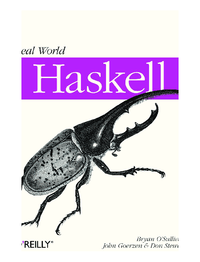
Real World Haskell
Programacion en Haskell
202 Visitas | 140 Descargas | 2014-03-03 15:22:57 | alvarojs
Haskell is a deep language; we think learning it is a hugely rewarding experience. We will focus on three elements as we explain why. The first is novelty: we invite you to think about programming from a different and valuable perspective. The second is power: we’ll show you how to create software that is short, fast, and safe. Lastly, we offer you a lot of enjoyment: the pleasure of applying beautiful programming techniques to solve real problems.
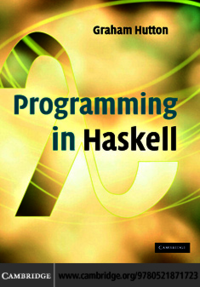
Programming in Haskell
Programación en Haskell
195 Visitas | 286 Descargas | 2014-03-03 15:25:13 | alvarojs
Haskell is one of the leading languages for teaching functional programming, enabling students to write simpler and cleaner code, and to learn how to structure and reason about programs. This introduction is ideal for beginners: it requires no previous programming experience and all concepts are explained from first principles with the aid of carefully chosen examples. Each chapter includes a series of exercises, ranging from the straightforward to extended projects, along with suggestions for further reading on more advanced topics. The presentation is clear and simple, and benefits from having been refined and class-tested over several years.

Yet Another Haskell Tutorial
Programacion en Haskell
147 Visitas | 106 Descargas | 2014-03-03 15:30:52 | alvarojs
The goal of the Yet Another Haskell Tutorial is to provide a complete intoduction to the Haskell programming language. It assumes no knowledge of the Haskell language or familiarity with functional programming in general. However, general familiarity with programming concepts (such as algorithms) will be helpful. This is not intended to be an introduction to programming in general; rather, to programming in Haskell. Sufficient familiarity with your operating system and a text editor is also necessary (this report only discusses installation on configuration on Windows and *Nix system; other operating systems may be supported – consult the documentation of your chosen compiler for more information on installing on other platforms).

The Haskell Road to Logic, Math and Programming
Programación en Haskell
188 Visitas | 121 Descargas | 2014-03-05 17:15:27 | alvarojs
The subject of this book is the use of logic in practice, more in particular the use of logic in reasoning about programming tasks. Logic is not taught here as a mathematical discipline per se, but as an aid in the understanding and construction of proofs, and as a tool for reasoning about formal objects like numbers, lists, trees, formulas, and so on. As we go along, we will introduce the concepts and tools that form the set-theoretic basis of mathematics, and demonstrate the role of these concepts and tools in implementations. These implementations can be thought of as representations of the mathematical concepts.
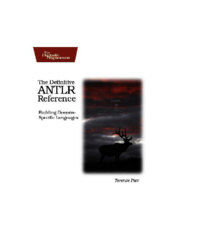
The Definitive ANTLR Reference
142 Visitas | 128 Descargas | 2014-03-11 13:36:37 | orosado
ANTLR is a parser generator that automates the construction of language recognizers. It is a program that writes other programs. From a formal language description, ANTLR generates a program that determines whether sentences conform to that language. By adding code snippets to the grammar, the recognizer becomes a translator. The code snippets compute output phrases based upon computations on input phrases. ANTLR is suitable for the simplest and the most complicated language recognition and translation problems. With each new release, ANTLR becomes more sophisticated and easier to use. ANTLR is extremely popular with 5,000 downloads a month and is included on all Linux and OS X distributions. Perhaps most importantly, ANTLR is much easier to understand and use than many other parser generators. It generates essentially what you would write by hand when building a recognizer and uses technology that mimics how your brain generates and recognizes language.

Mastering PowerShell
Windows powershell
145 Visitas | 143 Descargas | 2014-03-12 16:23:10 | raimels
Windows PowerShell es una interfaz de consola (CLI) con posibilidad de escritura y conjunción de comandos por medio de guiones (scripts en inglés). Es mucho más rica e interactiva que sus predecesores, desde DOS hasta Windows 7. Esta interfaz de consola está diseñada para su uso por parte de administradores de sistemas, con el propósito de automatizar tareas o realizarlas de forma más controlada. Originalmente denominada como MONAD en 2003, su nombre oficial cambió al actual cuando fue lanzada al público el 25 de Abril del 2006.
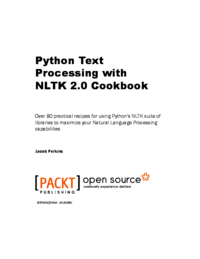
Python Text Processing with NLTK 2 CookBook
Natural Lenguage Processing
150 Visitas | 118 Descargas | 2014-03-13 17:02:48 | raimels
Natural Language Processing is used everywhere—in search engines, spell checkers, mobile phones, computer games, and even in your washing machine. Python's Natural Language Toolkit (NLTK) suite of libraries has rapidly emerged as one of the most efficient tools for Natural Language Processing. You want to employ nothing less than the best techniques in Natural Language Processing—and this book is your answer.

Thinking in C++
C++ programming & problem design
185 Visitas | 215 Descargas | 2014-03-13 17:16:49 | raimels
Like any human language, C++ provides a way to express concepts. If successful, this medium of expression will be significantly easier and more flexible than the alternatives as problems grow larger and more complex.
Contribuir
Usted puede contribuir con Libros UCLV, es importante para nosotros su aporte..
Contribuir