Categoría "Ingeniería Quimica"
Se han encontrado 38 Coincidencias
Water Chemistry
Chemistry
177 Visitas | 115 Descargas | 2014-12-16 14:00:34 | raulito
Around 1970, it was realised in the Department of Atomic Energy, BARC and Power Projects, that water chemistry research and development is essential for the smooth and safe operation oflndia's nuclear power reactors, as they all make use of light or heavy water as the heat transfer medium at high temperatures and pressures. To co-ordinate the effort, a Working Group on Power Re-actor Water Chemistry (PREWAC) was set up, which was later transformed into a Committee on Steam and Water Chemistry (COSWAC). I was associated with this effort from the beginning as the Convenor, PREW AC, Member-Secretary COSWAC and subsequently as its Chairman until the end of 1989. The International Atomic Energy Agency, refle,cting the world wide emphasis on this subject in the nuclear industry, conducted several co-ordinated Research Programmes on' Water Chemistry in Nuclear Power Stations during the 80s. I was privileged to be associated with this effort on behalf of the Department of Atomic Energy. In terms of infrastructure, BARC has set up a dedicated Water and Steam Chemistry Laboratory at Kalpakkam (Near Madras). In addition to chemical programmes, studies on marine biofouling were also initiated.

INTRODUCCIÓN A LAS OPERACIONES DE SEPARACIÓN Cálculo por etapas de equilibrio
223 Visitas | 146 Descargas | 2014-12-16 14:04:38 | raulito
Basta con consultar algunos de los libros de texto escritos sobre Operaciones de Separación para conocer la diversidad de temas que abarca esta materia (no todos los libros de texto tratan todas las operaciones de separación) y los distintos criterios y enfoques utilizados para su presentación. Esta obra no pretende ser un sustituto de textos convencionales de Operaciones de Separación sino que se presenta como una orientación para iniciar el estudio de los fundamentos de estos procesos. Está dirigida, especialmente, a los alumnos que cursan la asignatura de Operaciones de Separación I del Plan de estudios actual de Ingeniería Química de la Unversidad de Alicante. Su contenido se basa en las notas monográficas y generales, así como los apuntes y notas de otros profesores, centrándose en el tratamiento de las operaciones basadas en la transferencia de materia para el caso de contacto por etapas de equilibrio. A. Marcilla Gomis Introducción a las operaciones de separación ÍNDICE 8 Los primeros temas de este texto tienen un carácter general. Así, se comienza con un tema de introducción y conceptos generales, donde se exponen los distintos criterios de clasificación de las operaciones unitarias, describiendo las operaciones más convencionales controladas por la transferencia de materia y calor así como los diferentes tipos de contacto entre fases. Se continúa con el desarrollo de un tema dedicado a la descripción de diferentes equipos para el contacto entre fases, familiarizando al alumno con algunos de los dispositivos más frecuentes utilizados en la industria. Posteriormente se incluye un tema dedicado al equilibrio entre fases, tomado en su mayor parte de la obra de Costa Novella. Los temas cuarto y quinto se centran en el estudio de la primera operación seleccionada, haciendo referencia al proceso de destilación. Finalmente, el sexto tema (el más significativo de la obra y al que se ha dedicado un especial esfuerzo) se dedica a la rectificación de mezclas binarias, exponiendo un desarrollo -del que cabría resaltar los métodos gráficos- original de los autores. De este modo, la resolución del problema de diseño de columnas de rectificación complejas se presenta de un modo sistemático y generalizado. La exhaustividad con que se desarrolla este tema, servirá para fijar conceptos e introducir una metodología de trabajo extrapolable a otras operaciones de separación.

INTRODUCCIÓN A LAS OPERACIONES DE SEPARACIÓN Contacto continuo
219 Visitas | 154 Descargas | 2014-12-16 14:06:24 | raulito
Este libro surge como continuación de uno anterior dedicado fundamentalmente al cálculo de las Operaciones de Separación por etapas de equilibrio, y al igual que aquél, no pretende sustituir a otras obras clásicas de Operaciones de Separación, sino servir como herramienta de trabajo para los alumnos que cursan la asignatura Operaciones de Separación del Plan de Estudios de Ingeniería Química de la Universidad de Alicante de 1996. Está basado en otros libros generales, que se citan en cada capítulo, así como en apuntes y notas de otros profesores y en la experiencia docente acumulada tras años de impartir la asignatura, y se centra principalmente en el tratamiento de las Operaciones de Separación por contacto continuo.

Advances in Bioethanol
135 Visitas | 98 Descargas | 2015-01-07 17:16:18 | raulito
Disadvantages of fossil fuel derived transportation fuels (greenhouse gas emissions, pollution, resource depletion, unbalanced supply-demand relations) are strongly reduced or even absent with biotransportation fuels. Of all biofuels, ethanol is already produced on a fair scale. It produces slightly less greenhouse emissions than fossil fuel (carbon dioxide is recycled from the atmosphere to produce biomass); can replace harmful fuel additives (e.g., methyl tertiary butyl ether) and produces jobs for farmers and refinery workers. It is easily applicable in present day internal combustion engine vehicles (ICEVs), as mixing with gasoline is possible. Ethanol is already commonly used in a 10 % ethanol/90 % gasoline blend. Adapted ICEVs can use a blend of 85 % ethanol/15 % gasoline (E85) or even 95 % ethanol (E95). Ethanol addition increases octane and reduces carbonmonoxide, volatile organic carbon and particulate emissions of gasoline. And, via on board reforming to hydrogen, ethanol is also suitable for use in future fuel cell vehicles (FCVs). Those vehicles are supposed to have about double the current ICEV fuel efficiency. Ethanol production and use has spread to every corner of the globe. As concerns over petroleum supplies and global warming continue to grow, more nations are looking to ethanol and renewable fuels as a way to counter oil dependency and environmental impacts. World production reached an all-time high of nearly 23 billion gallons in 2010 and is expected to exceed 1,20,000 million mark by the end of the year 2020. While the US became the world’s largest producer of fuel ethanol in 2010, Brazil remains a close second, and China, India, Thailand and other nations are rapidly expanding their own domestic ethanol industries. Increased production and use of ethanol have also led to a growing international trade for the renewable fuel. While the vast majority of ethanol is consumed in the country in which it is produced, some nations are finding it more profitable to export ethanol to countries like the US and Japan. High spot market prices for ethanol and the rapid elimination of MTBE by gasoline refiners led to record imports into the US in the last few years. More than 500 million gallons of ethanol entered through American ports, paid the necessary duties, and competed effectively in the marketplace. The increased trade of ethanol around the world is helping to open up new markets for all sources of ethanol. The sustainable production of bioethanol requires well planned and reasoned development programs to assure that the many environmental, social and economic concerns related to its use are addressed adequately. The key for making ethanol competitive as an alternative fuel is the ability to produce it from low-cost biomass. Many countries around the world are working extensively to develop new technologies for ethanol production from biomass, from which the lignocellulosic materials conversion seem to be the most promising one. This e-book provides an updated and detailed overview on Advances in Bioethanol. It looks at the historical perspectives, chemistry, sources and production of ethanol and discusses biotechnology breakthroughs and promising developments, its uses, advantages, problems, environmental effects and characteristics. In addition, it presents information about ethanol in different parts of the world and also highlights the challenges and future of ethanol.
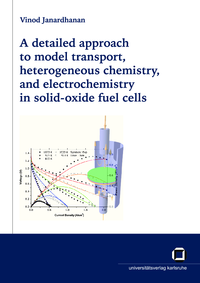
A detailed approach to model transport, heterogeneous chemistry, and electrochemistry in solid-oxide fuel cells
195 Visitas | 113 Descargas | 2015-01-07 17:19:12 | raulito
This dissertation layes out detailed descriptions for heterogeneous chemistry, electrochemistry, and porous media transport models to simulate solid oxide fuel cells (SOFCs). An elementary like heterogeneous reaction mechanism for the steam reforming of CH4 developed in our research group is used throughout this work. Based on assumption of hydrogen oxidation as the only electrochemical reaction and single step electron transfer reaction as rate limiting, a modified Butler-Volmer equation is used to model the electrochemistry. The pertinence of various porous media transport models such as Modified Fick Model (MFM), Dusty Gas Model (DGM), Mean Transport Pore Model (MTPM), Modified Maxwell Stefan Model (MMS), and Generalized Maxwell Stefan Model (GMS) under reaction conditions are studied. All model predictions are compared with experimental observations. In general MFM and DGM predictions are in good agreement with experimental data. Physically realistic electrochemical model parameters are very important for fuel cell modeling. Button cell simulations are carried out to deduce the electrochemical model parameters, and those parameters are further used in the modeling of planar cells. Button cell simulations are carried out using the commercial CFD code FLUENT [1] coupled with DETCHEM [2]. For all temperature ranges the model works well in predicting the experimental observations in the high current density region. However, the model predicts much higher open circuit potentials than that observed in the experiments, mainly due to the absence of coking model in the elementary heterogeneous mechanism leading to nonequilibrium compositions. Furthermore, the study presented here employs Nernst equation for the calculation of reversible potential which is strictly valid only for electrochemical equilibrium. It is assumed that the electrochemical charge transfer reaction involving H2 is fast enough to be in equilibrium. However, the comparison of model prediction with thermodynamic equilibrium reveals that this assumption is violated under very low current densities.

Algae for Biofuels and Energy
189 Visitas | 135 Descargas | 2015-01-07 17:21:59 | raulito
This book focuses on microalgae rather than seaweeds, as microalgae are the most attractive for renewable energy production, especially the production of biodiesel, although seaweed biomass can also be used. The aim of this book is to review in detail the most important aspects of the microalgae-to-bioenergy process, with an emphasis on microalgae as sources of lipids for the production of biodiesel and as potential sources of hydrogen. The book is meant as a guide and resource for both the experienced practitioners in the fi eld and to those newer to this exciting fi eld of research. However, no single book can cover all aspects of the production of bioenergy from algae; for example, we do not cover the fermentation of algal biomass to produce methane, nor the fermentation of algal sugars to ethanol or butanol. This book begins (Chap. 1 ) with an introduction to the history and developments over the last 80 years or so in the area of large-scale and commercial-scale culture of microalgae and the extensive literature that is available. Much can be learned from the extensive research that has been carried out, and by knowing this history (some of which is not easily accessible) we can avoid repeating past mistakes.

NANOBIOTECHNOLOGY BioInspired Devices and Materials of the Future
170 Visitas | 129 Descargas | 2015-01-31 20:49:29 | raulito
Nanobiotechnology is a multidisciplinary field that covers a vast and diverse array of technologies from engineering, physics, chemistry, and biology. It is expected to have a dramatic infrastructural impact on both nanotechnology and biotechnology. Its applications could potentially be quite diverse, from building faster computers to finding cancerous tumors that are still invisible to the human eye. As nanotechnology moves forward, the development of a ‘nano-toolbox’ appears to be an inevitable outcome. This toolbox will provide new technologies and instruments that will enable molecular manipulation and fabrication via both ‘top-down’ and ‘bottomup’ approaches. This book is organized into five major sections; 1. Introduction, 2. Biotemplating, 3. Bionanoelectronics and Nanocomputing, 4. Nanomedicine, Nanopharmaceuticals and Nanosensing, and 5. De NovoDesigned Structures. Section 1 is an introductory overview on nanobiotechnology, which briefly describes the many aspects of this field, while addressing the reader to relevant sources for broader information overviews. Biological materials can serve as nanotemplates for ‘bottom-up’ fabrication. In fact, this is considered one of the most promising ‘bottom-up’ approaches, mainly due to the nearly infinite types of templates available. This approach is demonstrated in Section 2.
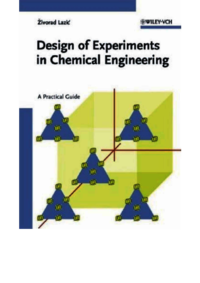
Design of Experiments in Chemical Engineering
153 Visitas | 185 Descargas | 2015-01-31 20:54:48 | raulito
The last twenty years of the last millennium are characterized by complex automatization of industrial plants. Complex automatization of industrial plants means a switch to factories, automatons, robots and self adaptive optimization systems. The mentioned processes can be intensified by introducing mathematical methods into all physical and chemical processes. By being acquainted with the mathematical model of a process it is possible to control it, maintain it at an optimal level, provide maximal yield of the product, and obtain the product at a minimal cost. Statistical methods in mathematical modeling of a process should not be opposed to traditional theoretical methods of complete theoretical studies of a phenomenon. The higher the theoretical level of knowledge the more efficient is the application of statistical methods like design of experiment (DOE). To design an experiment means to choose the optimal experiment design to be used simultaneously for varying all the analyzed factors. By designing an experiment one gets more precise data and more complete information on a studied phenomenon with a minimal number of experiments and the lowest possible material costs. The development of statistical methods for data analysis, combined with development of computers, has revolutionized the research and development work in all domains of human activities. Due to the fact that statistical methods are abstract and insufficiently known to all researchers, the first chapter offers the basics of statistical analysis with actual examples, physical interpretations and solutions to problems. Basic probability distributions with statistical estimations and with testings of null hypotheses are demonstrated. A detailed analysis of variance (ANOVA) has been done for screening of factors according to the significances of their effects on system responses. For statistical modeling of significant factors by linear and nonlinear regressions a sufficient time has been dedicated to regression analysis. Introduction to design of experiments (DOE) offers an original comparison between so-called classical experimental design (one factor at a time-OFAT) and statistically designed experiments (DOE). Depending on the research objective and subject, screening experiments (preliminary ranking of the factors, method of random balance, completely randomized block design, Latin squares, Graeco-Latin squares, Youdens squares) then basic experiments (full factorial experiments, fractional factorial experiments) and designs of second order (rotatable, D-optimality, orthogonal, B-designs, Hartleys designs) have been analyzed. For studies with objectives of reaching optima, of particular importance are the chapters dealing with experimental attaining of an optimum by the gradient method of steepest ascent and the nongradient simplex method. In the optimum zone up to the response surface, i.e. response function, one can reach it by applying secondorder designs. By elaborating results of second-order design one can obtain square regression models the analysis of which is shown in the chapter on canonical analysis of the response surface. The third section of the book has been dedicated to studies in the mixture design field. The methodology of approaching studies has been kept in this field too. One begins with screening experiments (simplex lattice screening designs, extreme vertices designs of mixture experiments as screening designs) through simplex lattice design, Scheffe's simplex lattice design, simplex centroid design, extreme vertices design, D-optimal design, Draper-Lawrence design, full factorial mixture design, and one ends with factorial designs of process factors that are combined with mixture design so-called "crossed" designs. The significance of mixture design for developing new materials should be particularly stressed. The book is meant for all experts who are engaged in research, development and process control.

CORROSION SCIENCE and TECHNOLOGY
147 Visitas | 103 Descargas | 2015-12-08 03:45:43 | raulito
Engineering metals are unstable in natural and industrial environments. In the long term, they inevitably revert to stable chemical species akin to the chemically combined forms from which they are extracted. In that sense, metals are only borrowed from nature for a limited time. Nevertheless, if we understand their interactions with the environments to which they are subjected and take appropriate precautions, degradation can be arrested or suppressed long enough for them to serve the purposes required. The measures that are taken to prolong the lives of metallic structures and artifacts must be compatible with other requirements, such as strength, density, thermal transfer, and wear resistance. They must also suit production arrangements and be proportionate to the expected return on investment. Thus, problems related to corrosion and its control arise within technologies, but solutions often depend on the application of aspects of chemistry, electrochemistry, physics, and metallurgy that are not always within the purview of those who initially confront the problems. Corrosion is the transformation of metallic structures into other chemical structures, most often through the intermediary of a third structure, i.e., water and a first task is to characterize these structures and examine how they determine the sequences of events that result in metal wastage.
HANDBOOK OF CANE SUGAR ENGINEERING
217 Visitas | 332 Descargas | 2015-12-10 13:44:37 | raulito
The technology of sugar manufacture has evolved so much in the course of the last twelve years that the preparation of a third edition has necessitated not only the revision of the major portion of the text but also the addition of numerous, entirely new sections. As important revisions and new sections, there will be found in particular in this new edition, the following: Powerful modern shredders Pressure feeders to mills, Australian type New formulae for maximal speed of mills A new formula for mill capacity A more complete table for calculation of power requirements in milling New systems of drive for mills Mill rollers The Lotus roller Calculation of weight of bagasse and weight of juices in the milling tandem Calculation of material balance in the tandem A new formula for reduced extraction A new type of diffuser liming of juice Rapid clarifiers Modification of existing clarifiers for rapid Dorrclones New formulae for heat-transfer coefficient in heaters Evaporator vessels with lateral or annular downtake Heat balance for the factory Falling-film evaporators Formulae for estimating coefficient k for flow in vessel and pan calandria Formulae for steam consumption of pans The method of calculating the material balance for the boiling house Continuous vacuum pans, including Langreney Vertical-crystalliser coolers Continuous centrifugals Sugar dryers Standard factory control Liquid-annulus air pumps Water requirements of the factory Forced-draught cooling towers Rain-type condensers and condenser heaters Drying of bagasse Steam balance of the factory for maximum economy Pelletisation of bagasse.
Análisis de la integración energética en los procesos tecnológicos de la industria azucarera
196 Visitas | 171 Descargas | 2015-12-10 14:12:12 | raulito
La producción de azúcar de caña, que ha sido a lo largo de muchos años uno de los más importantes renglones de nuestra economía, tiene la prioridad única, entre las grandes industrias, de obtener de la materia prima el combustible necesario para suministrar la energía que requiere el proceso y un exceso que se destina a consumidores externos. Esta alternativa ha sido explotada con muy poca intensidad manteniéndose un bajo aprovechamiento de las reservas energéticas que posee la caña, por lo que representa un pilar fundamental en el desarrollo económico del país. Es de vital importancia la proyección de ciclos termodinámicos más eficientes que los aplicados, para esto resulta una prioridad la construcción en los centrales azucareros de instalaciones adecuadas de generación eléctrica que independientemente de que no estén a la altura de los sistemas convencionales, tengan como ventaja que sean rentables con superioridad en los índices de generación que conduzcan al desarrollo de la eficiencia económica, con su propio combustible. Las tareas a ejecutar para garantizar la modernización de los ciclos termodinámicos eficientes están dadas por el uso de residuos cañeros (RAC) como combustible, la generación de energía eléctrica todo el año, la racionalización de los consumos propios de energía eléctrica contrarrestando el sobredimensionamiento, la sustitución de equipos de transferencias de calor por otros que garanticen la disminución de los consumos de vapor de escape en el proceso, y el aumento de la eficiencia de la planta de generación de vapor, etcétera.
BALANCES DE MASA Y ENERGÍA MÉTODOS CLÁSICOS Y TÉCNICAS NO CONVENCIONALES
168 Visitas | 177 Descargas | 2015-12-10 15:27:29 | raulito
En los primeros temas se abordan los aspectos clásicos acerca de la aplicación de los Balances de Masa y Energía y posteriormente se proponen métodos que ayudan a delimitar los esfuerzos, para evitar desgastes innecesarios. Aquí se valoran las relaciones entre los procesos principales y los servicios, así como técnicas de Modelación, que bien pueden ayudar a simplificar los análisis al enfrentarse a situaciones de extrema complejidad. Se complementa el estudio con aplicaciones a los bioprocesos, aspectos que a pesar de su importancia actual son poco estudiados por la literatura especializada y se analizan dos temas que ayudan en gran manera a la universalización de las técnicas en cuestión y son los correspondientes al análisis exergético, como vía de análisis del aprovechamiento energético y el estudio de la aplicación de balances en condiciones de incertidumbre.
Modeling of Liquid Phases Volume 2
199 Visitas | 104 Descargas | 2017-02-14 06:16:10 | raulito
This book – an in-depth examination of chemical thermodynamics – is written for an audience of engineering undergraduates and Masters students in the disciplines of chemistry, physical chemistry, process engineering, materials, etc., and doctoral candidates in those disciplines. It will also be useful for researchers at fundamental- or applied-research labs, dealing with issues in thermodynamics during the course of their work.

Thermodynamics of Surfaces and Capillary Systems
172 Visitas | 86 Descargas | 2017-02-14 06:18:12 | raulito
This seventh instalment is devoted to the study of surface phenomena and to the properties of phases with small dimensions. Chapter 1 looks at the system composed of the interface between a pure liquid and its vapor. A thermodynamic approach is used to determine the influence of the temperature and pressure on the surface tension and its consequences for the specific heat capacities and the latent heats. Chapter 2 describes the modeling and properties of the interfaces between a liquid and a liquid solution or a gaseous mixture. An example of a model of the interface is studied with the model of the strictly-regular solution. Chapter 3 examines the surfaces of solids and solid–solid and solid–liquid interfaces. It closes with the study of electro-capillary phenomena. Chapter 4 deals with smallPreface xiii volume phases, droplets or solids of small dimensions. The thermodynamic values are determined on the basis of Reiss’ potential functions. The chapter concludes with a thermodynamic study of the phenomenon of nucleation of a condensed phase. In Chapter 5, we study firstly the thermodynamics of cylindrical capillary, and secondly the properties of thin liquid films. Chapters 6 and 7, respectively, discuss the phenomena of physical adsorption and chemical adsorption of gases by solid surfaces. Finally, in an appendix, we present the application of physical adsorption to the determination of the specific areas of solids and their porosity.
Thermodynamics Modelling of Solid Phases
229 Visitas | 104 Descargas | 2017-02-14 06:19:40 | raulito
This volume of the set is devoted to modeling of solid phases. Chapter 1 discusses the modeling of pure solids. Oscillator models (Einstein’s and Debye’s) are used to calculate canonical partition functions for four types of solid: atomic, ionic, molecular and metallic. These canonical partition functions can be employed, first to calculate the specific heat capacities at constant volume, and second to determine the expansion coefficients with the Grüneisen parameters. Preface xi Chapter 2 looks at the modeling and characterization of solid solutions. Following a qualitative description of the different types of solid solution of substitution and insertion, the short-distance and long-distance order coefficients are introduced. Simple solution models are briefly described and the thermodynamics of the order/disorder transformations in alloys is presented. The chapter ends with the experimental determination of the activity coefficients of the components of a solid solution. The third chapter deals with non-stoichiometry of solids, and therefore point defects in pure solids. Equilibria between defects are discussed in the context of quasi-chemical phenomena. The fourth and final chapter looks at the question of point defects in solid solutions that are slightly or highly concentrated. The role of doping of insulating and semiconductive ionic materials is discussed, as is the description of models of gas dissolution in solids. The chapter finishes with an examination of the methods used to calculate the equilibrium constants of point-defect creation. Two appendices are given at the end of the book, discussing the Lagrange multiplier method and a method for solving Schrödinger’s equation.

Perry chemical engineering handbook, 9th edition
285 Visitas | 72 Descargas | 2019-12-19 18:37:50 | ycamaraza
Un manual especializado para ingeniería química, en su edición más reciente (2019). Es un clásico de la literatura especializada en ingeniería química, con casi 100 años a la vanguardia de la literatura del campo. espero sea de utilidad todos los profesionales de la UCLV y fuera de ella que acceden al mismo.

Kern's process heat transfer
transferencia de calor
207 Visitas | 240 Descargas | 2019-12-19 18:44:12 | ycamaraza
El libro es una versión actualizada (2019) y corregida del clásico libro de Donald Q Kern, que a lo largo de generaciones ha sido de amplia utilidad los estudiantes y profesionales de Ing química y mecánica

Fundamentos de termotransferencia
Transferencia de calor
225 Visitas | 144 Descargas | 2019-12-26 16:13:41 | ycamaraza
Es un clásico de la literatura soviética sobre la transferencia de calor, publicado por la editorial MIR. La escuela Soviética de termo transferencia proporcionaba un rigor sin igual en la presentación de los temas vinculados a la transmisión del calor, sin embargo en este material , sus autores brindan de forma amena, pero sin mermar el rigor científico, un material muy instructivo para un curso introductoria de la transferencia de calor. Es un libro de obligatoria consulta para aquellos que deseen adquirir una base sólida inicial en termo transferencia
Contribuir
Usted puede contribuir con Libros UCLV, es importante para nosotros su aporte..
Contribuir